

Rethinking pricing, packaging, and SaaS economics for agentic products
Why agentic AI needs a new monetization strategy
Agentic AI is driving a shift in agency, control, and human participation in software. Agents interpret goals, decompose tasks, and take autonomous action. As a result, software is evolving from deterministic workflows with humans as operators, into systems that plan and execute work autonomously with humans as supervisors.
This shift changes one of the core economic formulas of traditional SaaS. In classical SaaS, revenue, margins, and customer value grow closely with user adoption and interaction. While in an agentic product, the customer value primarily scales with improvements in AI models and agent autonomy. Traditional SaaS relies on a positive scale effect. More users mean higher revenue. While agentic products invert the scale formula: as autonomy increases, the number of required users decreases.
This means that product leaders can no longer treat a seat-based monetization model as the primary growth driver for agentic products. AI-first, agent-native products need a monetization strategy that accurately captures the value of these autonomous systems and aligns growth levers with advances in agent accuracy and autonomy. While the timeless anchors of cost, competition, customer value, and willingness to pay have not changed, the challenge in pricing has shifted from charging for access to software to pricing outcomes produced by autonomous and non-deterministic agents.
Four emerging pricing strategies
Most organizations are still working out how to charge for agentic AI in a way that reflects what it actually delivers. Four pricing models are emerging, each one holding up differently as agents become more capable and more autonomous.
Access-based pricing: familiar, but fragile
Access-based pricing is the model most people recognise. Vendors charge a flat recurring fee — typically per seat, for access to AI capabilities, sometimes with fair-use limits to prevent runaway consumption. Harvey, OpenAI with ChatGPT Enterprise, and Anthropic with Claude Teams all operate this way.
Although this pricing model give customers a simple and predictable buying journey, as AI performs more work independently, fewer human seats are required, reducing the need for more sales. Therefore, this pricing model can be viewed as a good starting point rather than the end state.
Product leaders can consider this strategy as a good starting entry point into the market. However problems may arise as a long term strategy, due to agentic AI advancing over time.
Consumption-based pricing: rational but limited
Consumption-based pricing charges customers for what the AI actually uses, tokens processed, compute consumed, interactions initiated. Salesforce with Agentforce, Cursor, OpenAI's APIs, and most public cloud AI services all work this way.
From the vendor's side, it makes sense. Revenue moves with usage, which makes margins easier to manage. But the model has two problems that compound over time.
The first is that cloud infrastructure keeps getting cheaper. When your pricing is anchored to compute costs, falling costs become a ceiling on revenue. And when customers see prices falling, they stop thinking of AI as something special and start shopping on price alone, the same way they buy storage or bandwidth.
The second problem is the customer's. There's often no clear line between what they're consuming and what they're getting for it. Model behaviour, prompt design, how retrieval is set up, all of it creates variability that makes consumption hard to predict and harder to justify in a budget conversation. As a result, this model frequently introduces unpredictability in customer budgets while failing to provide a straightforward value-to-cost narrative.
For product leaders, this pricing model is best suited for infrastructure products or for early-stage pricing models, while the customer value is still being refined.
Agent-based pricing: selling digital workers
In an agent-based pricing model, customers purchase individual agents via a recurring subscription. In this model, customers pay a recurring subscription for individual agents, each scoped to a role or task, rather than for access or compute. Some vendors abstract this further, skipping the per-agent count entirely and selling productive capacity. In other words, how much work they can get through.
Companies such as Microsoft (Copilot Studio) and 11x.ai price AI as deployable digital workers. Lovable and v0.dev price AI based on autonomous work or tasks that the system can complete, rather than discrete agent instances. Nominal uses an agent-centric pricing model based on the number of entities requiring consolidation. In a highly regulated industry like healthcare, Hippocratic AI offers role-specific agent-based pricing.
The model's problem right now is the gap between the promise and the reality. Most deployments still require a human to check the agent's output before anything gets acted on, which adds significant resource. As a result, customers view the gains from AI agents as limited, limiting their willingness to pay.
For product leaders, agent-based pricing is a promising model. The success of this model increases as agent reliability, quality, and autonomy reduce human resource and make digital labor economically credible. The sustainability of this agent-based pricing model will depend on how AI agents improve over time.
Outcome-based pricing: promising potential end state
In outcome-based pricing, the price of an AI product is directly aligned with tangible business outcomes for the customer. For example a resolved support ticket, recovered revenue, or a cost saving that shows up in the accounts. If the AI doesn't deliver, the customer doesn't pay.
This business outcome is directly correlated with ROI, such as realized financial outcomes or successfully completed tasks. The unit of value is the result. This model is most applicable for use cases where the AI's outcome is well-scoped and can be reasonably attributed to the AI. Vendors and customers often have difficulty agreeing on how to define a tangible business outcome and isolate the AI system's contribution to that outcome from other factors.
Companies such as Sierra use outcome-based pricing, in which customers only pay for tasks completed successfully. Chargeflow’s pricing is tied to the percentage of recovered revenue. Intercom has a hybrid approach, combining a capacity model in the base product with outcome-based pricing in the higher-value product. Customers progressively shift from a consumption model to an outcome model. The outcome-based pricing model introduces greater risk for the vendor, but it is the most future-proof.
For product leaders, outcome-based pricing is a promising long-term pricing model, but it requires operational maturity in attribution and measurement, as well as trust, to become prevalent.
A decision framework for pricing agentic products
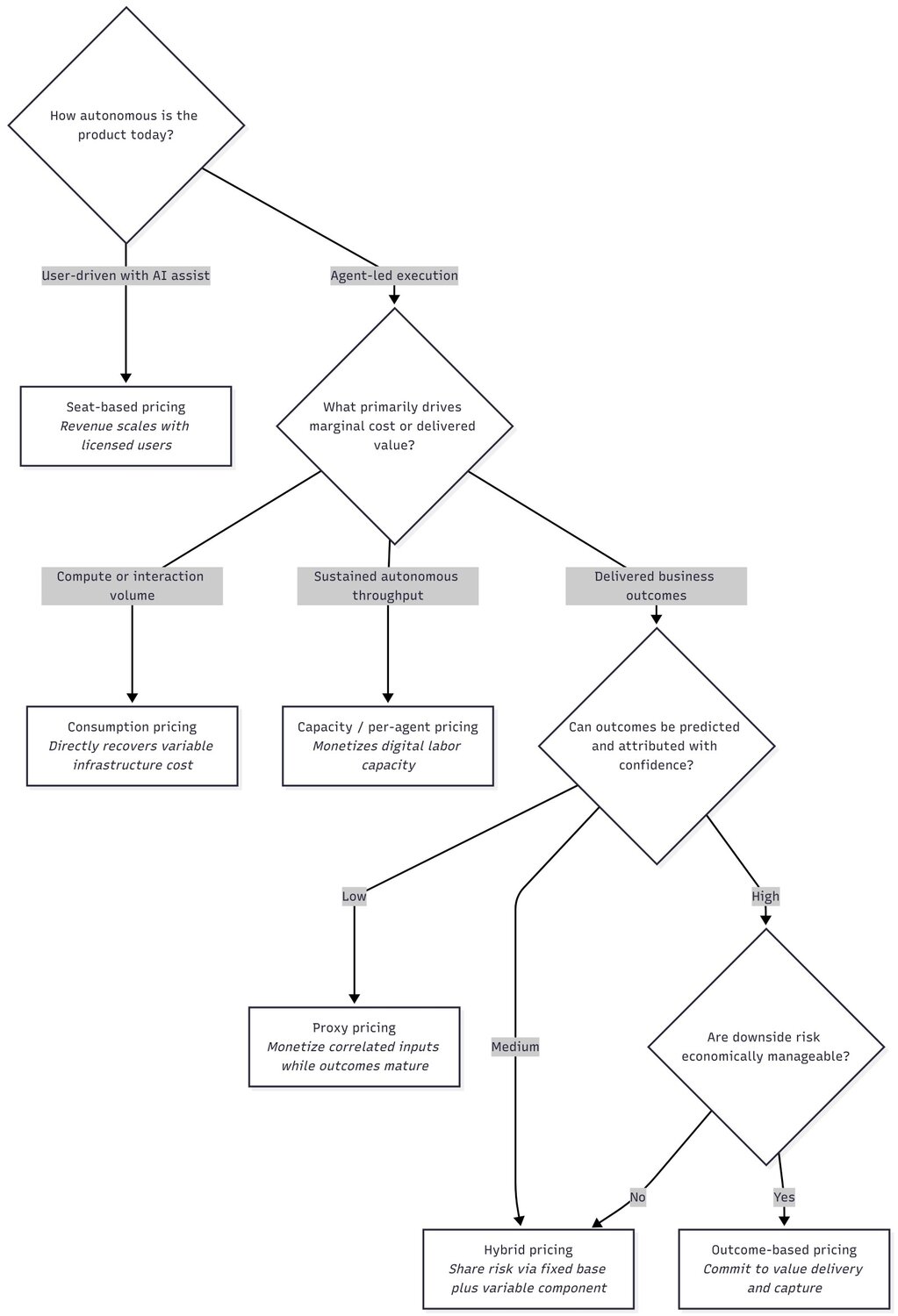
Product leaders should adopt a two-step approach for pricing agentic products. First, identify pricing models that are economically and technically viable; then select the model that best aligns with how customers perceive, budget, and justify value.
As shown in the decision tree below, the viability of different pricing models depends on agent autonomy, cost structure, outcome predictability, attribution clarity, and risk tolerance. This step ensures that the pricing model is aligned with the agentic product’s technical maturity and the organization's financial constraints.
The second step, as shown in the decision tree below, aligns the pricing model with customers' perceived value, ensuring pricing reflects how customers budget and measure ROI. This step reduces sales friction by aligning with the customer’s preferred value frame.
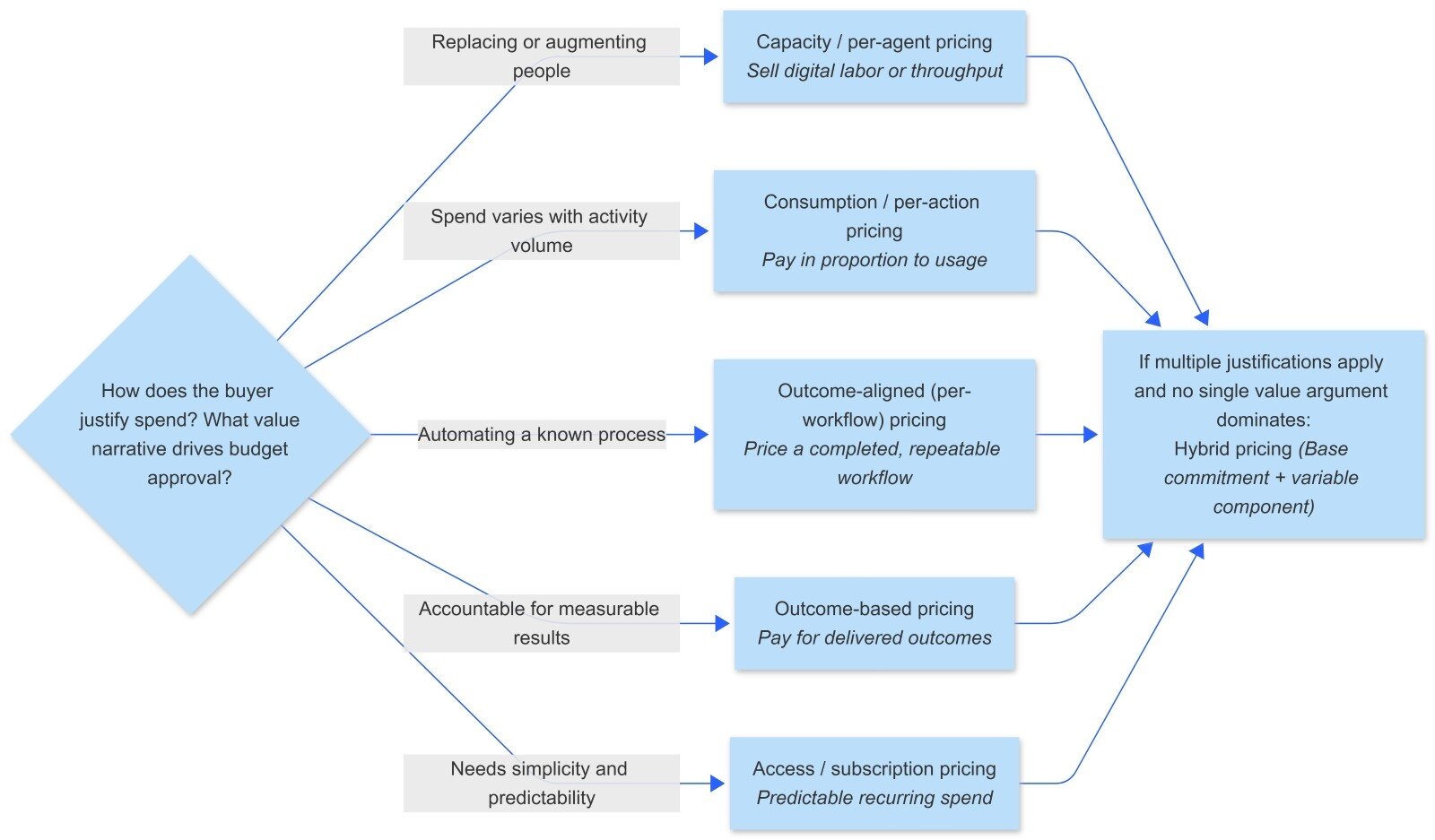
As technology matures and agentic products improve in accuracy and autonomy, product leaders should use this framework to iteratively evolve their pricing strategy.
Putting the framework in practice
Consider a team building an agentic cloud-cost-optimization product. The product scans cloud infrastructure, assesses thousands of resources, and automatically performs cost-optimization operations. Approximately 42% of operations require human approval. The overall cost savings are verifiable, but attributing them solely to agent actions is difficult.
The framework in Figure 1 identifies viable pricing models. Seat-based pricing is not the strongest option because value correlates with autonomous execution, not user count. Consumption-based pricing protects margins, but as marginal costs decline and autonomous efficiency improves over time, this model becomes suboptimal. Given the product’s partial autonomy and the debatable attribution of outcomes, full outcome-based pricing is premature. The framework leads to agent-capacity pricing.
The second framework covers the buyer’s perspective. Consider a mid-sized organization that spends millions of dollars annually on cloud infrastructure and realizes meaningful, recurring savings from the product. Pricing based on agents, tokens, and actions will be misaligned with how finance teams construct budgets. The value proposition that gets budget approved is accountable savings (outcome-aligned) implemented through a hybrid pricing structure. For instance, if the product delivers $200,000 in annual cloud savings, it might be priced as a $40,000 fixed subscription plus 5% of realized savings.
This two-step approach leads to a pricing model that is structurally viable for the vendor and is aligned with how customers justify, approve, and renew expenditure.
Packaging strategy for agentic products
In traditional SaaS, the “good, better, best” packaging is often used to implement feature-based bundling and tier gating. In agentic products, the familiar “good, better, best” construct persists, but the differentiation among tiers is based on cognitive capability, autonomy, accuracy, and scope of AI agents. For example, the base or free package of ChatGPT or Claude offers a basic assistant with limited reasoning. As we move from the free tier to the plus, pro, or max tier, each tier offers an increase in cognitive ability. These packages are designed to create a self-reinforcing loop in which adoption drives learning, learning improves the accuracy and autonomy of agents, and higher autonomy and accuracy unlock greater user value, which in turn accelerates adoption.
Product leaders should view packaging strategy as a core growth strategy. It should align customer lifetime value optimization with advancements in agentic AI.
Conclusion
Agentic AI is fundamentally reshaping the value chain of software products. For product leaders, monetization is now a core element of the overall product strategy, not a downstream exercise to optimize the product adoption funnel and margins. The imperative is to design a monetization strategy that scales with improvement in the accuracy and autonomy of AI agents. The pricing strategy for agentic products should align the customer's perceived value model with an economic model that maximizes customer lifetime value and helps build a competitive moat.
