

When people talk about product management, they usually picture feature roadmaps, customer interviews, and incremental releases tied to a clearly defined product. I used to think about it the same way.
Some of the most important product lessons I’ve learned, however, didn’t come from building features. They came from leading large-scale enterprise transformations where the “product” was a collection of systems, data structures, and workflows that hundreds or even thousands of employees depended on every day.
There were no launch announcements or conversion dashboards. Success looked quieter: fewer workarounds; fewer urgent escalations; a steadier operating rhythm. Failure showed up as confusion, resistance, and temporary spreadsheets that slowly became permanent.
What surprised me most was how directly product thinking applied. The same principles that make external products successful—understanding users, prioritizing outcomes, designing for trust, and measuring adoption—matter just as much internally. The signals are subtler, and the feedback loops are slower, but the fundamentals are the same.
Why product thinking still matters when there’s no product team
Enterprise transformations are often framed as execution-heavy initiatives. Systems must be migrated. Data must be moved. Timelines are fixed. The work is categorized as operational rather than product-led.
That framing can be misleading.
Even without a formal product team, transformations still have users. They still require trade-offs. They still need a clear definition of success beyond going live. Earlier in my career, I focused heavily on delivery milestones. We were on schedule and organized. We closed tasks efficiently. Yet adoption lagged because we had not spent enough time thinking about how the change would land for the people actually using it.
Once I began treating transformation work like product work, building roadmaps tied to outcomes rather than just tasks, the quality of decisions improved. Conversations shifted from “Are we on track?” to “Is this actually working for our users?”.
Employees are users, too, not just stakeholders
One of the most important mindset shifts for me was recognizing employees as primary users, not simply stakeholders to be informed.
In enterprise environments, it is easy to assume that internal users will adapt because the change is necessary. In practice, that assumption creates friction. When workflows become slower or more complex, productivity drops and workarounds appear.
I remember sitting with an operations team member shortly after a major system transition. She was not resistant to the change. She was frustrated because what used to take three clicks now took nine, and no one had clearly explained why. The system technically worked, but in her daily reality it felt heavier. That conversation changed how I approached transformation work. If a change makes someone’s job harder without a clear benefit, adoption will stall no matter how strategically important the initiative is.
Since then, I make it a habit to ask product-style questions in planning discussions:
- Who will use this daily?
- What will change in their workflow on day one?
- Where will they feel friction first?
- What is the minimum they need to succeed without calling support?
You do not always need formal research to answer these questions. Sitting with a process owner for 30 minutes and walking through real examples often reveals more than a slide deck ever will.
Prioritization when everything feels critical
Enterprise transformations create an environment where everything feels urgent. Every team has dependencies. Every request sounds critical. Without strong prioritization, progress quickly becomes reactive.
I learned to reframe prioritization around outcomes rather than urgency. Instead of asking which task should be completed next, I focused on which changes would unblock the most users, reduce operational risk, stabilize the system fastest or prevent expensive rework later.
One practical tool I use is a simple user impact score. Before prioritizing a change, we assess how many users it affects, how frequently they encounter it, and how disruptive it is if it fails. Even a lightweight scoring approach reduces emotional decision-making and anchors conversations in measurable impact.
Maintaining a visible decision log also proved valuable. Documenting what we decided, why we decided it, what we deferred, and what would trigger a revisit reduced repeated debates and increased trust, even when the answer was “not yet.”
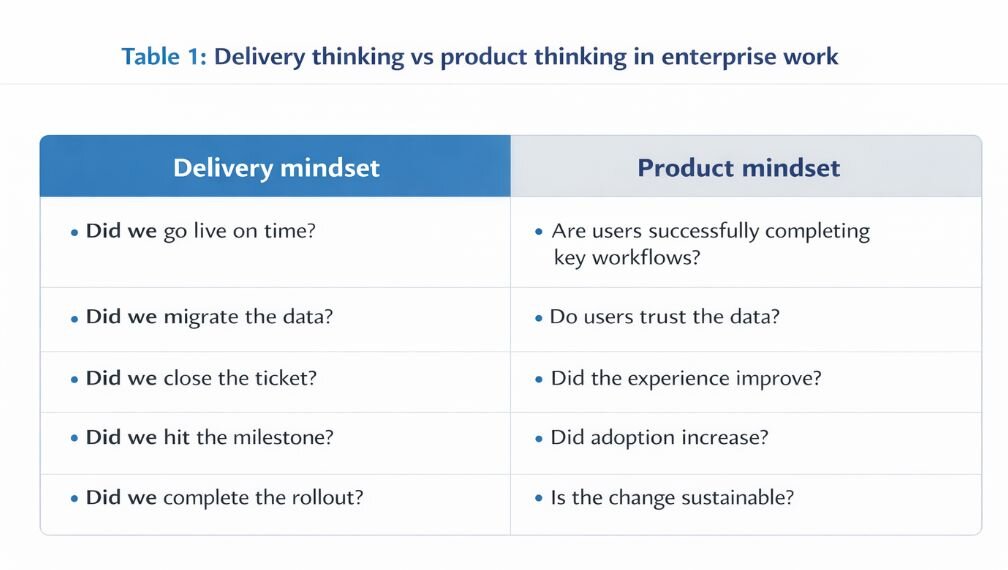
When I began contrasting delivery-focused questions with product-focused ones, I noticed how differently teams approached decisions. The difference can be summarized like this:
Data is part of the product, whether you plan for it or not
In many transformation efforts, data is treated as a technical detail. In reality, data quality and structure shape user experience just as much as interfaces and workflows.
From a product perspective, poor data is a broken feature.
- Inconsistent definitions confuse users.
- Missing fields create manual workarounds.
- Duplicate records erode trust.
- Unclear ownership turns small issues into ongoing escalations.
Treating data readiness as a product requirement changed how I approached planning. That did not mean aiming for perfection, but it did mean defining what good enough looked like for launch, identifying which fields mattered most to users, agreeing on validation steps, and clarifying ownership when conflicts surfaced.
If you do not define what acceptable data quality looks like upfront, users will define it for you later, often through frustration.
Shipping is not the finish line
One of the hardest lessons for me was accepting that delivery does not equal success. Systems can go live and still fail from a product perspective if users do not adopt or trust them.
Over time, I began to view transformation work as a cycle rather than a linear project with a finish line. Go-live marks the beginning of adoption, not the end of effort.
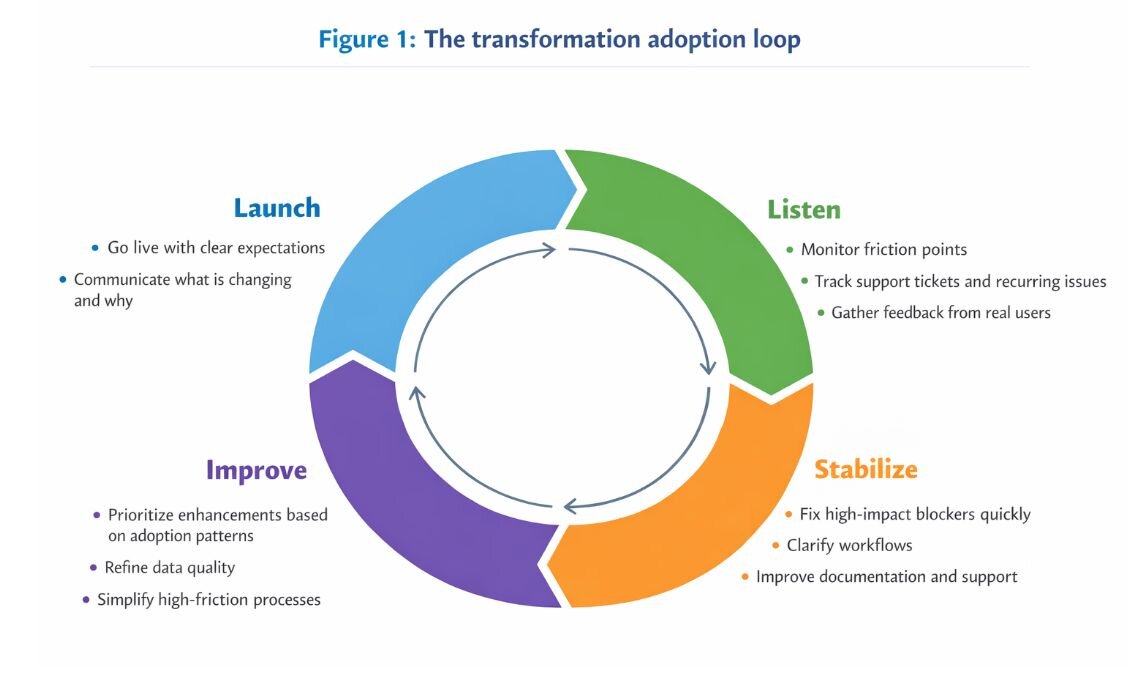
This mindset changed how I measured success. In enterprise transformations, success often appears in subtle signals:
- Fewer support tickets and escalations
- Fewer manual workarounds
- Faster completion of key workflows
- More consistent process adherence
- Greater confidence in reporting and decision-making
Planning explicitly to launch, listen, stabilize, and improve helped teams anticipate friction rather than fear it. When learning is expected, iteration becomes normal instead of reactive.
Trust is the hidden requirement
Transformations struggle when trust erodes. Users may comply outwardly while quietly maintaining parallel systems or escalating minor issues because they do not believe stability will last.
Trust is built through consistent experiences:
- Clear communication about what is changing and why
- Accessible training and responsive support
- Fast resolution of high-impact issues
- Transparency when something is not yet ready
Trust is observable. When repeat escalations decline and workarounds disappear, confidence is increasing.
Practical checklist: Applying product thinking in enterprise transformation work
If you are a product manager or product-minded leader working on enterprise initiatives, these steps might help. I have consistently relied on them when moving from delivery-focused execution to outcome-focused leadership:
- Define user groups clearly and break them into real roles.
- Write a simple day-one experience narrative.
- Create outcome-based success measures tied to adoption and stability.
- Treat data readiness as a product requirement.
- Make trade-offs visible through transparent prioritization.
- Plan explicitly for post-launch learning and iteration.
What this means for product managers
You do not need to work on consumer-facing products to practice strong product management. Some of the most complex and influential product work happens inside organizations where systems, data, and people intersect.
Enterprise transformations stretch product skills in different ways. They demand systems thinking, stakeholder leadership, comfort with ambiguity, and a sustained focus on outcomes rather than outputs.
Product thinking is not limited by context. It is an approach to problem-solving. And sometimes, the most impactful products are the ones no one ever labels as a product at all.
