


Introduction: Turning product vision into economic value
The strategic success of any product-driven organization, particularly its design and engineering departments, is intrinsically linked to one fundamental metric: the ability to maximize Return on Investment (ROI). In the complex, high-stakes world of modern product development, where capital, talent, and time are the most valuable and finite resources, the core objective is not simply to "ship code" or "delight users." It is to rigorously optimize the combination of given inputs to maximize quantifiable economic outputs.
For design and engineering teams, the inputs are the dedicated resources, meaning the salaries, cloud infrastructure costs, tooling budget, and, most critically, the time spent on discovery, design, testing, and coding. The output, and the ultimate measure of success, is the economic return generated by a newly released feature, an improved service, or a brand-new product line. This return must be measured through the lens of company profitability, not just immediate user engagement. Without a rigorous, ROI-centric focus, product managers, designers, and engineers risk devolving into a "feature factory," perpetually busy but ultimately failing to generate sustainable, compounding economic value. This alignment of technological effort with business strategy is the highest calling of effective product leadership.
The product manager’s pitfalls: How biases undermine ROI
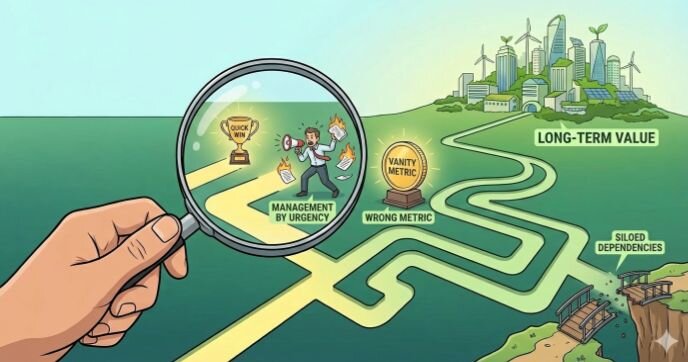
The road to successful product delivery is paved with good intentions, yet a surprising number of initiatives fall short. This failure often stems not from technical incompetence, but from fundamental decision-making biases that blind the product team to the true cost and value of their work. Product managers must establish robust guardrails against these four common pitfalls that systematically erode ROI.
1. Management by urgency: The erosion of strategic focus
This is perhaps the most common and destructive bias. It describes the chronic failure to consistently apply structured, objective approaches to project evaluation, leading to prioritization based on immediate noise rather than long-term economic signal. Strategic roadmaps become reactive documents, perpetually derailed by the "fire of the week."
- The shiny object syndrome:
One of the most common KPI traps product managers fall into is what I call the shiny object syndrome. It happens when proximity to influential leaders, perceived authority, or internal politics pulls focus toward an unvalidated initiative. These distractions can drain resources from core strategic deliverables, leading to significant delays and measurable financial impact.
I experienced this firsthand while working on our company’s new line of EVs. My team was fully engaged in developing a next-generation powertrain—lightweight, compact, and far more efficient than its predecessor. Just as we were making steady progress, an executive became excited about entering the adjacent e-bike market. It seemed promising at first, and the pressure to align with leadership’s enthusiasm was hard to ignore. But as we soon discovered, the idea lacked proper validation and a clear path to product-market fit. In chasing that shiny opportunity, we diverted key resources and ultimately delayed our core EV launch by eight months—a costly reminder that focus and prioritization are just as critical as innovation itself.
- The loudest complaint bias:
The loudest complaint bias shows up when the needs of the biggest or highest-paying customer start to outweigh the needs of the broader user base. The roadmap quietly shifts from being product-led to account-led, and the product drifts away from what the wider market actually needs.
This happened while leading delivery of a new software architecture for ADAS features. We had a clear, phased plan to build a strong, scalable foundation. After an MVP demo, our largest client became fixated on one flagship feature, and their excitement quickly turned into urgent requests.
Wanting to keep them happy, we pulled resources off core infrastructure work to focus on that one capability. That decision created an avoidable crunch at the end of the project and forced the team into a rushed finish. Letting urgent, one-off requests steer the roadmap creates chaos, hurts efficiency and morale, and usually leads to weaker long-term returns.
2. Measuring the wrong metric: Mistaking activity for achievement
Many product teams are excellent at tracking metrics but terrible at targeting metrics that are truly correlated with economic ROI. They focus on easily trackable vanity metrics, confusing "activity" with "achievement."
- Engagement trap and total acquisition cost:
- Another subtle KPI trap is celebrating high engagement on a new feature without understanding what it truly costs to create and sustain that engagement. It is not enough to know that users are clicking, returning, or spending time; those metrics must be weighed against the full product development cost and the marketing spend required to drive users to that feature. Ignoring this total acquisition cost can turn a seemingly “successful” feature into a long-term drag on profitability.
Working on a SaaS product for the robotics developer community reinforced this lesson. Before committing to new features, significant time went into mapping out the cost impact and tracking it against realistic revenue projections. That meant asking hard questions upfront: Are customers actually willing to pay for this? Does it meaningfully support upsell opportunities or higher-tier plans? By treating every feature request as an investment decision—rather than a simple engagement lever—the roadmap stayed aligned with sustainable growth, not just impressive-looking usage metrics.
- Metric deception:
Acting toward a misleading objective almost guarantees you will miss what truly matters for the company’s success. When the core metric is misaligned with strategy, teams can work hard, ship fast, and still move in the wrong direction.
This became clear while building and deploying a simulation product for robotics and self-driving vehicles. Early on, the chosen North Star metric was the number of users, which pushed the team toward launching new features and entering new markets instead of strengthening what already existed. Monthly user counts looked healthy, but attrition told a different story: roughly 80% of users tried the product once and never returned. Shifting the primary focus from new user registrations to user retention changed how priorities were set and led to more sustainable growth. Choosing a North Star that aligns with the company’s strategy is essential; the “right” metric clarifies trade-offs, steers investment, and keeps the product moving toward durable value rather than vanity success.
3. Missing the inter-organizational dependencies: The cost of isolation
Effective product prioritization is not an exercise confined to the engineering backlog; it is an organizational-wide optimization problem. PMs who fail to recognize and account for cross-functional dependencies invariably create costly bottlenecks and erode the ROI of the entire organization.
- The revenue dependency and timing:
When shaping a roadmap, it is important to recognize that timing and revenue are closely intertwined. Prioritizing features that can deliver quick, meaningful revenue wins helps de-risk long-term bets and keeps the product funded and credible inside the organization.
In practice, this has meant focusing on features that are both critical for users and that increase utilization of existing infrastructure, since higher utilization translates directly into revenue dollars for the firm. By deliberately sequencing work so that these revenue-generating capabilities land early, the development process becomes more self-sustaining. This approach supports continued investment in the product without relying solely on future, uncertain payoffs.
- The holistic timeline failure:
A common trap in roadmap planning is looking only at the software timeline and ignoring upstream and downstream dependencies. When those dependencies are not fully understood, delivery dates become optimistic guesses rather than reliable commitments, and even well-built products can miss their moment.
Working in robotics makes this painfully clear. The software side of a product may be relatively easy to deploy and scale, but it is fundamentally constrained by how quickly new hardware components, sensors, and actuators can be built, tested, and shipped. Failing to account for these dependencies has led to unwanted outcomes and misaligned launches. The lesson is straightforward: as a product manager, understanding the holistic timeline—across suppliers, hardware partners, and internal teams—is essential. Coordinating closely with these partners is what enables a realistic plan and a smooth, well-timed release.
4. The short-termism trap: Sacrificing sustainability for immediate wins
Many product managers fall into the trap of prioritizing rapid, short-term growth or "quick wins" at the expense of long-term sustainable value. While these wins can boost near-term metrics, they often come with hidden costs that eventually erode the total ROI.
- The high-risk segment bias:
Another subtle trap is over-focusing on the easiest segment to serve instead of the one that truly drives sustainable growth. Low-friction segments can create quick adoption and positive sentiment, but if they are not aligned with your long-term revenue model, they can quietly pull the roadmap away from where the business actually needs to go.
This tension shows up clearly in enterprise products for Physical AI. Researchers and students are often enthusiastic early adopters and can work with rough edges in UI, UX, and security, making them tempting to prioritize. However, they are not usually the primary revenue engine. Enterprise customers, on the other hand, demand more robust features and higher standards but are essential for meaningful, sustainable growth. Keeping enterprise clients at the center of prioritization—even when it is harder—ultimately enables continued investment in the product and, in turn, makes it possible to keep supporting the research community as well.
Having company ROI as a north star ensures every prioritization and resource deployment decision is efficient, effective, and aligned with the maximized economic benefit for the entire organization.
How to set metrics that are correlated to ROI

Moving beyond bias requires adopting a comprehensive, financial framework for evaluating product initiatives. The goal is to calculate a project's true economic impact, not just its potential impact on a single, isolated metric.
Understand a comprehensive ROI framework
A project’s true economic impact must be mapped across four distinct financial components. This framework forces a disciplined assessment of both sides of the ledger (revenue and cost) and the potential second-order effects.
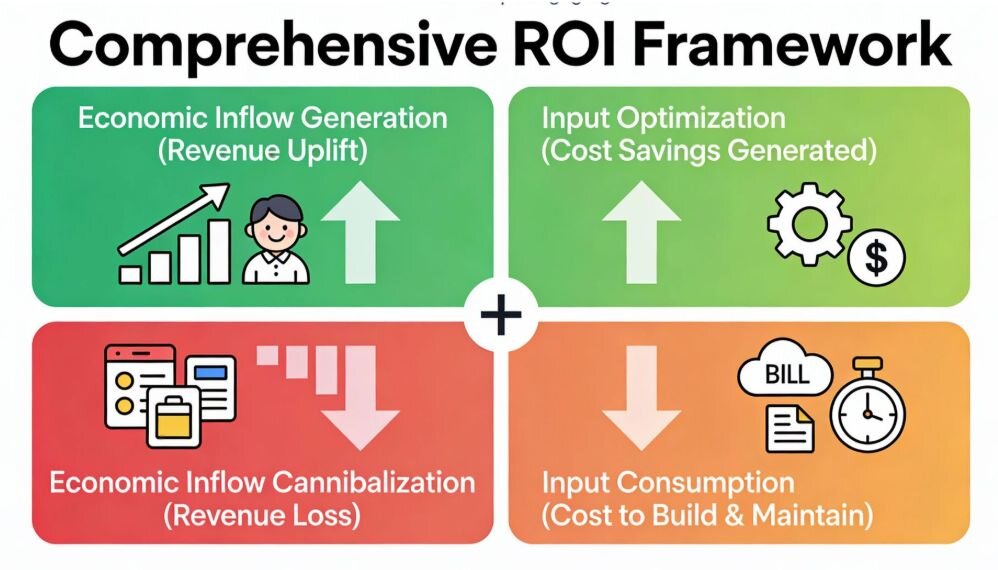
1. Economic inflow generation (revenue uplift): This is the direct, positive economic value generated.
- Example metrics: Increase in Average Revenue Per User (ARPU), increase in conversion rate from free-to-paid, additional users/subscriptions acquired, increase in average transaction value.
2. Economic inflow cannibalization (revenue loss): This accounts for any revenue that is displaced or lost as a result of the new initiative.
- Example metrics: Loss of revenue from sunsetting an existing product line, reduction in cross-sells due to reduced visibility of another product, or churn from specific user segments who object to the change.
3. Input consumption (cost to build & maintain): This measures the direct and indirect cost of the product team’s efforts.
- Example metrics: Cost of labor (salaries, external contractors), licensing/cloud consumption costs (AWS, GCP), capital expenditure for new hardware/tools.
4. Input optimization (cost savings generated): This measures the efficiency gains the product delivers, often saving money in other departments.
- Example metrics: Reduction in customer support tickets (a better UX reduces calls, leading to staff cost savings), automation that reduces manual work in Operations or Finance, reduction in server load/maintenance through better code efficiency.
Consider the full impact on all ROI contributors
When evaluating any project, the PM must explicitly estimate the effect across all four components. This is the essence of a rigorous business case.
- Holistic revenue impact analysis: The estimation must not be based on an assumed "average user." It requires analyzing the differential impact on all user types. For instance, new features that helped my product to break into new markets drives up GPU usage, increasing revenue but it would mean higher pricing which will result in churn of legacy users that are price sensitive . Maintaining the balance between these two factors becomes key in successful deployment.
- Metric and target setting: For every component impacted, relevant underlying metrics must be listed, and rigorous, quantifiable targets must be set before development begins. These targets form the basis of the post-mortem analysis.
Time as the needle mover: Quantifying the cost of delay
The time factor is a critical, often-underestimated variable in product prioritization. A dollar earned today is worth more than a dollar earned tomorrow, this is a foundational principle of finance (i.e., Time Value of Money).
- Accelerated returns: Achieving the same total Return on Investment one year earlier than planned is exponentially better because those resources (the profit generated) are unlocked sooner and can be redeployed on the next ROI-generating project. This accelerates the compounding effect of successful investments.
- The cost of delay (CoD): PMs must quantify the CoD, which is the amount of value lost by delaying a project by a month or a quarter. The prioritization decision then becomes $Value/CoD$. Projects with a high CoD (e.g., a time-sensitive market entry or a feature required for a Q4 sales cycle) should always be prioritized highly, even if the absolute development cost is substantial. This rigorous application of financial principles is what separates tactical managers from strategic product leaders.
The feedback loop: In-progress and post-mortem monitoring
The decision to launch a product is merely the halfway point; sustained value creation requires continuous financial vigilance and a disciplined commitment to learning.
Establish continuous monitoring routines
Project success cannot be measured by a single release date. Formal processes must be implemented to track the economic performance of product investments.
- Operating committee reviews: Establish a routine (e.g., monthly) cross-functional operating committee review. This forum is dedicated not to discussing features, but to systematically checking the actual performance and validating the KPIs assumptions. The ultimate focus is on the impact on the four components: actual revenue uplift, actual cannibalization, actual cost, and actual savings.
- Assess deviations and recalibrate for precisions: When performance deviates from the planned business case, the PM must immediately initiate a structured root-cause analysis, define remediation plans and recalibrate any KPI.
- Example: If Economic Inflow Generation is 50% lower than planned, the remediation might involve increasing marketing spend, adjusting the pricing model, or deploying A/B tests to optimize the conversion funnel.
- Example: If Input Consumption is higher due to unforeseen cloud costs, the remediation involves working with engineering to refactor for efficiency or adjusting the project's financial assumptions. The key is continuous action, not passive reporting.
The post-mortem: Deriving lessons for future ROI
Once a project has run its course (e.g., 6-12 months post-launch), a formal post-mortem analysis is non-negotiable. This is the highest-leverage activity for improving future capital allocation.
- Gap analysis: Conduct a rigorous gap analysis comparing the actual ROI generated against the planned ROI outlined in the initial business case. Did the project hit the target revenue? Did it cost more or less than expected? Was the cannibalization effect larger?
- Root-cause investigation: This analysis must move beyond what happened to why it happened. Was the initial market sizing flawed? Was the cost estimation poor? Did the team underestimate the complexity? The failure to hit ROI targets often exposes flaws in core organizational processes, whether in market research, estimation, cross-team collaboration, or initial target setting.
- Deriving lessons learned: The final output of the post-mortem is a set of quantifiable, actionable lessons that inform future projects. This information is critical for improving the accuracy of future business cases, enhancing risk assessment, and ultimately ensuring that the next cycle of product investment starts with a higher likelihood of maximizing economic returns.
By institutionalizing this rigorous, ROI-driven framework, from unbiased evaluation and comprehensive metric setting to continuous monitoring and disciplined post-mortem learning, product managers transform their role from tactical delivery management to strategic, economic value creation.
